Intro to Textiles Industry Web
A lightweight educational website designed to organize fragmented textile engineering study material into a more accessible and navigable learning resource.
⚠️ Content in Spanish.
This is an ongoing project. It’s continuously updated with new study material.
🧩
The Problem
As a first-year student of textile engineering, introductory concepts accumulated across PDFs, handwritten notes, recorded lectures and slide decks. Revisiting information became increasingly frustrating, especially during exam periods.
Study material was fragmented, difficult to scan quickly, and distributed across inconsistent formats. Accessibility and quick retrieval of information quickly became central concerns.
The challenge wasn’t creating more content, but reducing the friction of accessing and revisiting it.
👤
User Context
While the experience was initially designed desktop-first, responsive layouts became increasingly important as students frequently revisited concepts from mobile devices shortly before exams.
Typical usage scenarios include:
Reviewing concepts shortly before exams
Quickly checking terminology during class
Revisiting diagrams from mobile devices
Navigating large amounts of material without opening multiple PDFs
🎯
Goals
Centralize scattered material
Improve readability and scanability
Reduce navigation friction
Keep the experience lightweight and fast
Make concepts easier to revisit under time pressure
⚠️
Constraints
Environmental Constraints
Inconsistent Wi-Fi availability in classrooms and labs
Students frecuently accessing material from mobile devices
Large original resources (PDFs/slides) slowing down quick review sessions
Project Constraints
Zero infrastructure budget
Minimal maintainance requirements
Need for easy long-term content updates
📐
Design Decisions
Content-first structure
Hierarchical sections
Reduced visual clutter
Emphasis on readability
Lightweight architecture
Static site: mostly HTML/CSS
Minimal JavaScript
Fast loading and low maintenance
Responsive review experience
Adaptable layouts
Mobile readability
Quick access during short review sessions
Simplified navigation
Fewer nested interactions
Direct access to concepts
Consistent structure between sections
📈
Outcome
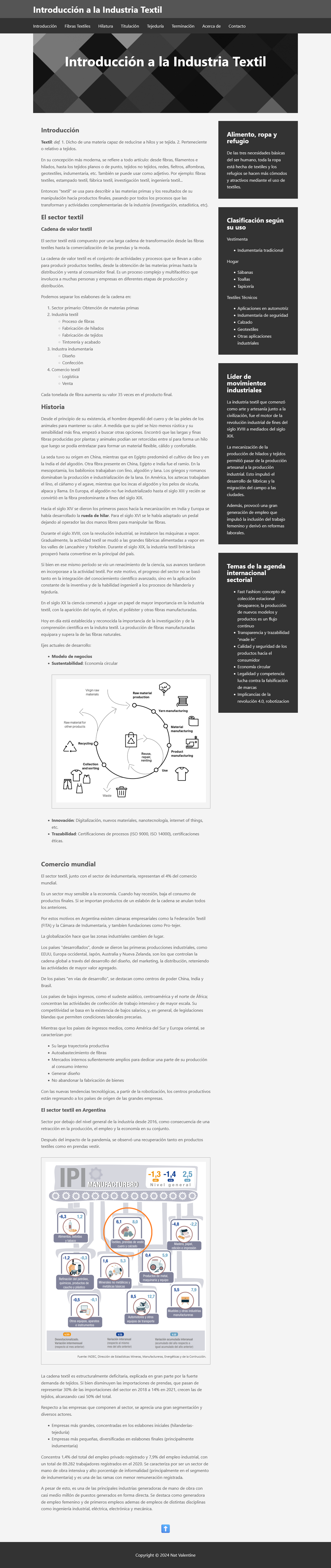
Centralized previously fragmented study material into a single accessible resource
Created a faster review workflow for introductory textile engineering concepts
Developed a lightweight educational tool optimized for low-friction access
Shared publicly as an open study resource for other students
💭
Reflection
Since students often accessed the material in classrooms with unreliable connectivity, performance and low friction became more important than feature richness. The project reinforced how much usability can improve learning experiences even without complex functionality. Organizing information clearly and reducing interaction friction often had a bigger impact than adding new features.
As the content evolved into more technical topics, maintaining clarity and accessibility became increasingly challenging, particularly for notation-heavy material.
One unexpected aspect of the project was realizing how difficult long-term information maintenance can become as educational material continuously grows and changes over time.
In future iterations, I would explore search, tagging systems and user feedback mechanisms.